
Crown Hair Loss: Causes in Men and Women

Crown hair loss can result from androgenetic alopecia, diffuse shedding, alopecia areata, traction, inflammation, or scarring disease. The shape, speed, scalp symptoms, and condition of follicle openings help separate these causes. Because the crown is hard to view directly, standardized photos and a professional examination are especially useful.
Why the crown often looks thinner
The natural whorl separates hair in multiple directions, so even a healthy crown can show scalp under direct overhead light. Wet or oily strands clump together and increase contrast. That means one alarming photo does not establish hair loss.
True thinning becomes more likely when the visible area expands, density feels lower, or surrounding strands become finer over time. Compare images taken under identical conditions rather than judging photos from different hair lengths and lighting.
Common causes in men
Male pattern baldness
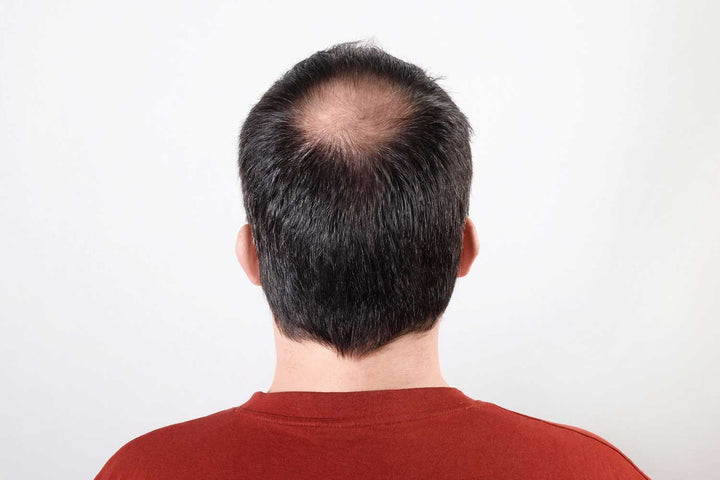
Androgenetic alopecia commonly thins the vertex, sometimes before the frontal hairline changes. DHT-sensitive follicles miniaturize gradually. The Norwood scale includes vertex patterns, but not every man follows the same sequence.
Telogen effluvium
Illness, major stress, surgery, rapid weight loss, or medication changes can shift many follicles into the resting phase. Shedding is usually diffuse, yet the crown may look most noticeable because of its whorl and lighting.
Alopecia areata
This autoimmune condition can create a smooth round patch at the crown. It may also affect beard, brows, lashes, or nails. Prompt confirmation matters because treatment differs from pattern loss.
Common causes in women
Female pattern hair loss often reduces density over the crown and widens the central part without causing a fully bald spot. Hormonal transitions, thyroid disease, iron deficiency, and acute telogen effluvium can overlap with it.
Women with tightly curled hair deserve particular attention to central crown loss. Central centrifugal cicatricial alopecia, or CCCA, commonly starts at the vertex and can permanently destroy follicles if inflammation continues. Tenderness, itching, burning, breakage, or a shiny area with fewer follicle openings should prompt early dermatology care.
How crown loss is diagnosed
A clinician will ask when the change began, whether shedding increased, what symptoms are present, and what happened two to four months before onset. Dermoscopy can reveal miniaturization, broken hairs, inflammation, scale, or loss of follicle openings. A pull test helps assess active shedding.
Blood testing may include a complete blood count, ferritin, thyroid tests, or other studies based on the history. A biopsy can be important when scarring alopecia is possible. The goal is not to order every test, but to answer the most plausible clinical questions.
Treatment depends on the cause
- Pattern loss: Topical minoxidil is a common first-line option. Clinicians may discuss oral minoxidil, finasteride, dutasteride, or spironolactone when appropriate.
- Telogen effluvium: Identify and correct the trigger, then allow the growth cycle time to recover.
- Alopecia areata: Corticosteroids and other immune-directed treatments may be used.
- Inflammatory or scarring loss: Early anti-inflammatory treatment aims to prevent further permanent loss.
- Traction: Stop repeated tension before scarring develops.
Do not apply a popular treatment blindly to an undiagnosed crown spot. Minoxidil may help pattern loss but will not control a scarring inflammatory disorder by itself.
Daily steps that support hair quality
Use gentle detangling, minimize high heat and tight styles, and keep the scalp clean with products suited to your texture and symptoms. Adequate protein and micronutrients support normal hair structure. Noophoric Hair+ is an optional source of daily nutritional support for healthy-looking hair, not a treatment for the underlying diseases that can cause crown loss.
Frequently asked questions
Is a visible crown whorl always balding?
No. A whorl naturally exposes some scalp. Progression, miniaturization, and lower density are more informative than visibility alone.
Can crown hair grow back?
Often it can improve when follicles remain alive and the cause is treated. Scarring alopecia can permanently destroy follicles, which is why early diagnosis matters.
Why does my crown look worse under bathroom lights?
Overhead light reflects directly from exposed scalp between hairs. Oil, wetness, short hair, and camera processing can amplify the effect.
Bottom line
Crown thinning is a location, not a diagnosis. Track it consistently, notice symptoms, and seek evaluation for progression, a defined patch, or scalp discomfort. Treatment has the best chance when it addresses the actual cause.
Evidence reviewed September 2026. This article is educational and is not a substitute for individualized medical diagnosis or treatment.
*These statements have not been evaluated by the Food and Drug Administration. This product is not intended to diagnose, treat, cure, or prevent any disease.
Sources

The information on noophoric.com is for informational and educational purposes only and is not intended to be medical advice. Readers should consult with a qualified healthcare professional before making changes to diet, nutrition, supplementation, medication, or lifestyle.